Custom Retail Box for Earphones: MOQ and What to Send the Factory Before Your First Order
A buyer's guide to ordering a custom retail box for earphones — the MOQ gap, the files your factory needs, and how to approve the dieline before production.
You have picked your earphones. You have agreed the logo. You are ready to order — and then the factory asks for your packaging files, and the order stops.
This happens to first-time private label buyers more than almost any other delay. The earphones themselves are straightforward: pick a model, confirm the specification, approve a sample. The retail box is a second product with its own rules. It has its own minimum order quantity, its own artwork requirements, and its own approval step, and none of those match the earphones. A buyer who plans only for the earphones ends up waiting on the box.
This guide explains the three things you need to settle before you order a custom retail box for earphones: the MOQ, the files the factory needs from you, and the approval sequence that keeps a wrong box from reaching your customers.
Why the Box Is Usually the Part That Delays Your Order
Earphones are small, light and quick to make. A standard model can go from confirmed sample to bulk shipment in days. A custom box cannot move at the same speed, because a box is printed, die-cut, creased and glued — four separate operations, each with its own setup.
The mismatch shows up in three places.
First, the quantities do not match. At HOEXI, a standard earphone order starts at 1 pc, and laser engraving starts at 5 pcs. A custom retail box starts at 500 pcs. Packaging suppliers generally list the same range: folding cartons and rigid boxes commonly start at 500 units, and many earphone packaging programs start at 1,000. If you order 200 earphones with a custom box, the factory can make the earphones — but the box run is below its minimum, and the order waits while you decide whether to raise the quantity, simplify the box, or ship the first batch in neutral packaging.
Second, the files do not arrive ready. The factory needs print-ready artwork laid out on a dieline, not a logo file and a photo of a box you like. A buyer who sends a PNG logo and a reference photo has sent the start of the job, not the job itself. The artwork has to be rebuilt, checked against the dieline, and approved — and every round of fixes adds days.
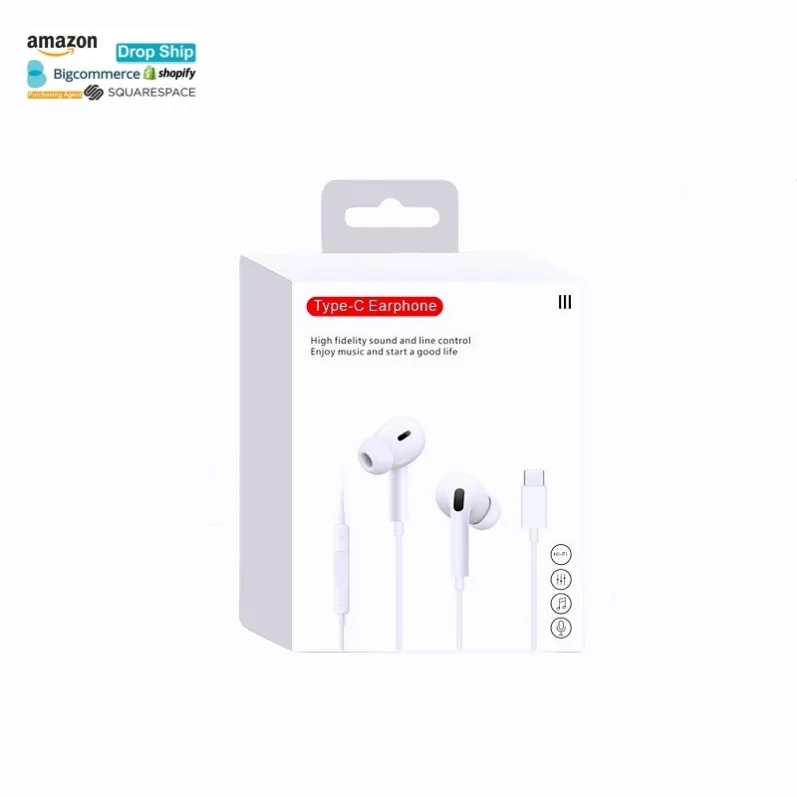
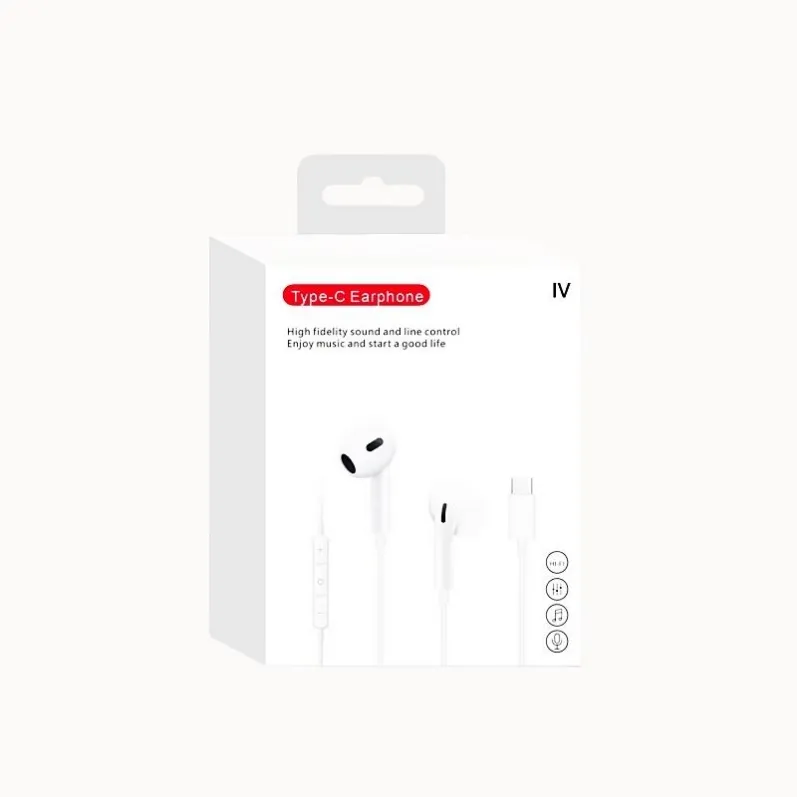
Third, the box has to fit the product exactly. A retail box designed for one earphone model does not automatically fit another. A Type-C wired model with an inline remote and a coiled cable needs a different insert from a TWS model with a charging case, spare ear tips and a short cable. A box drawn for the wrong model is a box that crushes the cable, lets the case rattle, or will not close. The fit has to be confirmed on a real sample, not assumed from a drawing.
None of this is difficult once you know it. It is only expensive when you discover it after the earphones are already in production.
The MOQ Gap: Earphones vs Boxes
The single most useful number in this guide is the gap between the two MOQs. Understand it, and most packaging surprises disappear.
At HOEXI the standard terms are: standard earphones from 1 pc; laser engraving from 5 pcs; silk printing from 500 pcs; custom packaging from 500 pcs. The custom packaging figure is the one buyers miss, because it is far above the earphone MOQ and far above the laser engraving MOQ. It is also the figure that decides your first order size if you want a fully branded product from day one.
Why is the box minimum higher? A box run has fixed setup costs that do not shrink with quantity: plates, dies, cutting formes and machine setup. A printing factory spreads those costs across the run, and below a few hundred units the setup costs more than the boxes. That is why packaging suppliers publish minimums of 500 to 1,000 units for custom work, while the same suppliers will print a plain structural sample in ones and twos. Custom packaging is part of our OEM and private label service, and it is quoted together with the earphones so the two minimums are checked against each other before you commit.
What this means for your order depends on how many earphones you are buying.
- Under 500 pcs: a custom retail box is usually not the right first step. Order the earphones with laser engraving — the minimum is 5 pcs — and ship in the factory's standard packaging, or in a neutral box with a branded sticker or sleeve. You get a branded product without paying for a box run you cannot use yet.
- At 500 pcs and above: a custom box becomes practical. Your earphone quantity and your box quantity finally match, and the per-unit cost of the box falls to the level the factory quoted.
- At 1,000 pcs and above: you can afford the more expensive structures — rigid boxes, magnetic lids, foil stamping — because the setup cost is spread across a run large enough to absorb it.
One practical rule follows from this: never let the box decide your earphone quantity, and never let your earphone quantity decide your box. Decide both separately, then check that they match. If they do not match, change the packaging plan, not the order — a neutral box with a printed sleeve can carry your brand while your volume grows into a full custom run.
The Four Box Types Buyers Actually Order
Most custom earphone boxes fall into four structures. Knowing which one you are asking for saves a round of back-and-forth, because each one has a different MOQ, a different cost band, and a different job to do.
1. Folding carton. A printed paperboard box that ships flat and folds up at the factory. This is the standard retail box for wired earphones and most TWS models: light, cheap to ship flat, easy to print, and available with a hang tab so it can go on a retail peg. If you sell online or through small phone shops, this is usually the right choice. It is also the easiest structure to change later, because a new print run needs only new artwork, not a new die.
2. Rigid box. A stiff greyboard box wrapped in printed paper — the two-piece lid-and-base box, the magnetic closure box, the drawer box. Rigid boxes feel premium and protect the product better, which is why they are used for flagship TWS models and gift sets. They cost more per unit, take up more shipping volume because they ship assembled, and usually carry the highest minimums. Order rigid only when the retail price of your product justifies it.
3. Sleeve and tray. A printed sleeve that slides over a plain inner tray or a standard carton. This is the budget route to a branded look: the sleeve carries all the printing, the tray underneath stays the same across models, and reorders only need a new sleeve. It is the best option when you carry several earphone models and want one consistent brand look without paying for a custom die per model.
4. Mailer box. A corrugated box designed to survive the courier network on its own, with no outer carton. Mailer boxes matter for dropshipping and direct-to-consumer sellers, because the box is the parcel. If your customers receive the product in the box it was packed in, the box has to survive being thrown, stacked and sorted — a folding carton inside a mailer is fine, a folding carton on its own is not.
When you write to the factory, name the structure you want. "A nice box" is not a specification. "A folding carton with a hang tab, matte lamination, for a Type-C wired earphone with inline remote" is a specification a factory can quote from.
What to Send the Factory: The File Checklist
A factory can quote and produce a custom box from six things. Send all six in your first message, and you will get an accurate answer instead of a week of questions.
1. The earphone model and its real dimensions. Name the model — for example, our EM-F4C Type-C wired earphones — and send the dimensions of the product as it will actually sit in the box: the earphones, the cable as folded, the charging case if there is one, spare ear tips, and the manual. Measure the product itself, not a box you already use, because that box may be the wrong size and you would only be copying its mistakes. Tell the factory the exact contents list: every item that goes inside, including the cable and the tips, because the insert is designed around the full contents, not just the earphones.
2. The box structure and material. Folding carton, rigid box, sleeve and tray, or mailer — plus the board you want if you know it. If you do not know the board, say so and let the factory recommend one. A folding carton for earphones is usually a coated paperboard; a rigid box is usually wrapped greyboard. Say whether the box needs a hang tab, a die-cut window, or a tamper-evident seal.
3. Print-ready artwork, laid out on the dieline. The artwork file should be a vector PDF or AI file, in CMYK, with fonts outlined and images at high resolution. Packaging printers commonly ask for 3 mm bleed on all sides and a safe zone inside the fold lines, so text and logos do not sit on a crease. If you only have a logo, send the vector logo and tell the factory the factory's design team can lay it out — but expect a design round and a proof before production, not a same-day print.
4. Pantone references for brand colours. If your brand colour has to match — and for a logo it usually does — send the Pantone code, not a screen photo. Screens lie about colour. A Pantone reference lets the printer mix the ink to your colour instead of guessing from a JPEG.
5. Barcode and regulatory zones. Tell the factory which barcode goes on the box — your own barcode, an Amazon FNSKU, or the manufacturer's barcode — and where it sits. Leave a clear, unprinted zone for it in the artwork, away from fold lines and glue flaps, so it stays scannable after lamination. If your market needs regulatory marks such as CE, tell the factory which marks and where they go. This is the detail most often forgotten, and the one most likely to force a reprint.
6. The channel the box is sold through. A box for a retail shelf needs a hang tab and shelf impact. A box for an e-commerce parcel needs to survive the courier. A box for Amazon FBA needs the FNSKU placement confirmed. Tell the factory where the box ends up, because the structure, the board and the finishing all follow from it.
Our guide on what to include in an RFQ to get an accurate earphone quote in 24 hours covers the same discipline on the earphone side — a complete specification in the first message is what makes a fast, accurate quote possible.
The Dieline, Explained in Plain English
The dieline is the flat template of your box: every panel, every fold line, every glue flap, drawn to scale. It is the single most important document in a custom packaging order, and the one buyers most often misunderstand.
Think of it as the sewing pattern for the box. The factory draws the dieline from your product dimensions, then your artwork is laid onto it — front panel, back panel, sides, flaps — so that when the flat sheet is cut, folded and glued, the design lands exactly where it should. A logo that looks centred on a screen can land on a fold line if the artwork was laid out on the wrong dieline, or on a size that was never drawn at all.
The normal sequence is: you send the product dimensions and contents, the factory draws the dieline, you approve the dieline, the artwork is set onto it, you approve a flat proof and a 3D mock-up, and only then does production start. Nothing goes to press until you approve it in writing. If a factory offers to skip the dieline approval and print straight from your artwork, that is a warning sign, not a shortcut.
Two rules protect you here. First, approve the dieline for the exact model you are ordering — a dieline drawn for one earphone model does not transfer to another, even if the earphones look similar. Second, keep the approved dieline on file. When you reorder, or order the same box for a second model, the factory pulls the same file and the second run matches the first. Factories that keep your dielines, material specifications and Pantone standards on file are the ones whose reorders match; factories that redraw from scratch every time are the ones whose colours drift.
Sample the Box Before the Run
Never approve a full box run from a drawing alone. Ask for a sample, and ask for the right kind of sample.
A plain structural sample is a blank box cut and folded from the dieline, with no printing. It answers the physical questions: does the product fit, does the insert hold it still, does the lid close, does the hang tab hold the weight? It is quick to make and it is the sample to ask for when the structure is new.
A printed pre-production sample is the real box with your artwork on your board. It answers the visual questions: is the colour right, is the text in the right place, does the barcode scan, does the finish look the way you expected? It takes longer, because it goes through the same printing and finishing as the full run — but it is the only sample that can catch a colour or layout mistake before you own 500 of them.
At HOEXI, earphone samples take 5–7 days, and a custom logo sample is the step we recommend before any bulk order — our guide on getting a sample with your logo before a bulk order explains how that works for the earphones themselves. For the box, build the sample time into your schedule the same way: the box sample is not a delay added to your order, it is the step that keeps a wrong box from becoming a wrong shipment. If your launch date is fixed, start the packaging conversation before you start the earphone conversation, because the box will take longer than the earphones.
Five Mistakes That Waste a Packaging Run
Most bad box runs come from the same five mistakes. All five are avoidable, and all five are cheaper to fix on a sample than on 500 printed boxes.
1. Measuring the old box instead of the product. A box you already use may be the wrong size for the new model. Measure the earphones, the cable, the case and the tips as they will actually ship, then let the factory draw the dieline from those numbers.
2. Sending artwork that was never laid on the dieline. A logo file is not box artwork. Artwork has to sit on the dieline with bleed, safe zones and fold lines respected. If your designer has never worked with a dieline, ask the factory to set the artwork — and approve the flat proof before it goes to press.
3. No bleed, or text on a fold line. Printers need 3 mm of bleed so the colour runs to the edge after cutting, and text needs a safe zone inside the fold. Artwork without bleed prints with a white edge; text on a crease cracks when the box is folded. Both are caught on a flat proof if someone checks it.
4. Forgetting the barcode zone. A barcode printed across a fold, under a gloss lamination that reflects the scanner, or covered by a sticker is a barcode that does not scan — and a retail buyer who cannot scan your box will send it back. Reserve the zone in the artwork, and scan the printed sample before approving the run.
5. Ordering the box for the wrong model. A box drawn for a wired earphone does not fit a TWS charging case, and a box drawn for one TWS model does not fit another with a taller case. Confirm the model name, the contents list and the dieline together, on the same message, before you approve anything.
How to Time Packaging with Your Earphone Order
The practical question is not how long a box takes. It is when to start it so the box and the earphones arrive together.
Work backwards from your ship date. Non-custom bulk earphone orders ship in 3–7 days from confirmation, and a sample takes 5–7 days — those are the fast parts of the order. The box is the slow part: dieline, artwork, proof, sample, then the print run. If you start the packaging conversation on the same day you confirm the earphones, the box will be late. Start the box first, or at least in parallel, and confirm the earphone sample while the box artwork is being set.
A workable sequence for a first private label order is: send the model, contents and artwork files together in your first message; approve the dieline; approve a logo sample of the earphones — laser engraving starts at 5 pcs, so you can hold the branded earphone in your hand early — and approve the printed box sample; then confirm the bulk order with a 30% deposit and the balance before shipment. Each approval is a gate: nothing downstream starts until the gate is passed, which is exactly why the gates save time instead of costing it.
If you are unsure which logo method suits the earphones themselves, our comparison of laser engraving vs silk printing on earbuds explains which one lasts longer and when each one makes sense. The logo on the earphone and the box around it are two halves of the same brand decision — settle both before you pay a deposit on either.
Frequently Asked Questions
Can I order a custom box for fewer than 500 earphones?
Custom packaging starts at 500 pcs, while standard earphones start at 1 pc and laser engraving at 5 pcs. Below 500 pcs, use the factory's standard packaging with a branded sleeve or sticker, and move to a full custom box when your volume reaches the box minimum.
What file format should my artwork be in?
A vector PDF or AI file, in CMYK, with fonts outlined, high-resolution images, and 3 mm bleed. If you only have a raster logo, send the highest-resolution version you have and let the factory's design team rebuild it as a vector — and approve the proof before production.
Who draws the dieline — me or the factory?
The factory draws it from your product dimensions and contents list. You approve it. If you have your own packaging designer, they can work from the factory's dieline, but the factory's version is the one production follows.
How do I know the box will fit my earphones?
Ask for a plain structural sample first, put your actual product inside it, and check the fit, the insert and the lid. A printed sample then confirms the colour and layout. Never approve a run from a drawing alone.
Can the same box design be used for a second earphone model?
Only if the second model has the same dimensions and the same contents. In practice, a new model needs its own dieline and its own fit check, even if the artwork stays the same. Keep the approved dieline on file so reorders match.
Get Your Custom Box Quoted with Your Earphones
A custom retail box is not an accessory to your earphone order. It is a second product with its own MOQ, its own files and its own approval sequence — and when it is planned properly, it is the part of your order your customers actually see first.
Send us the model, the contents list and your artwork files, and we will draw the dieline, confirm the 500 pc custom packaging minimum against your quantity, and quote the box with the earphones in one message. Standard earphone orders start at 1 pc, laser engraving at 5 pcs, samples in 5–7 days, and non-custom bulk orders in 3–7 days — with a 30% deposit and the balance before shipment.
Get a Quote or message us on WhatsApp at +86 135 3021 9863, and tell us the model, the box structure you want, and where the box will be sold. We will come back with a dieline plan and a timeline that gets the box and the earphones to you together. Our earphones carry a 4.9/5 rating, and our packaging is handled the same way our orders are: checked against a sample, confirmed in writing, and matched to the product inside.