Laser Engraving vs Silk Printing on Earbuds: Which Logo Lasts Longer for Private Label Orders?
A private-label buyer's guide to laser engraving vs silk-screen printing on earbuds: how each logo wears, what each needs in minimum order, and which keeps your brand visible.
Your logo is the only part of a private-label earphone that does the selling after the sale. The sound, the cable, the packaging — the customer experiences those once. The logo is what they see every time they pick the earbuds up, what their friends see, and what they remember when they decide whether to buy from your brand again. A logo that fades, cracks or rubs off in the first month does more damage than a scratched shell: it tells the customer the whole product is cheap, even when the sound is fine.
This is the failure buyers keep running into, and it is almost always a process decision made before the order was placed. Laser engraving and silk-screen printing are the two logo methods most factories offer first, and they fail in completely different ways. One is permanent but colourless; the other is colourful but sits on the surface, waiting to wear off. Choosing between them is not a design preference. It is a decision about material, order size, and how the product will actually be used — and the right answer changes with all three.
This guide explains how each method works on earbuds, where each one fails, and how to decide which one fits your order before you pay for a sample.
1. Laser Engraving: The Logo Becomes Part of the Product
Laser engraving — also called laser marking — does not add anything to the earphone. A focused laser beam removes a microscopic layer of the shell material itself, leaving a recessed mark in the shape of your logo. There is no ink, no film and nothing sitting on the surface to peel.
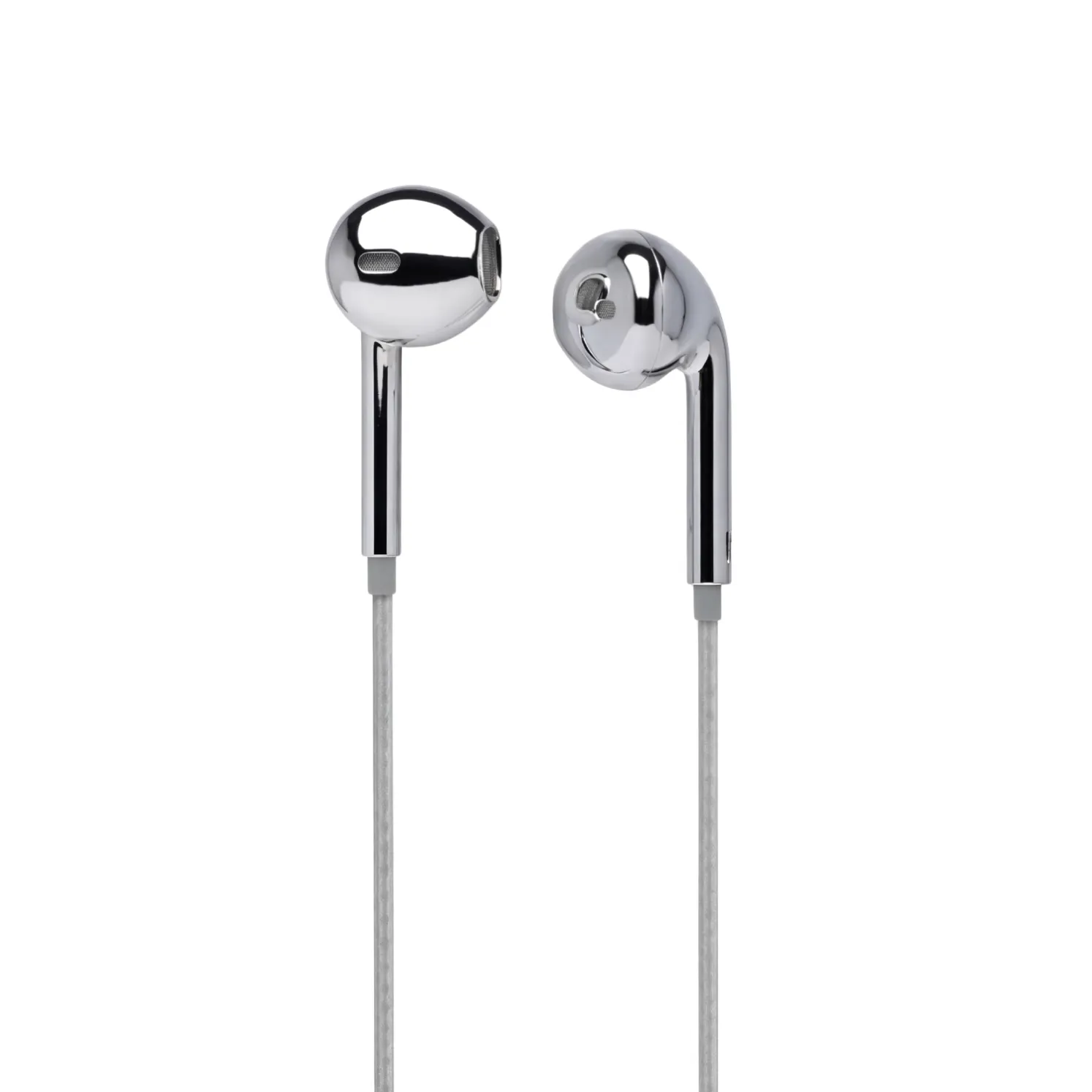
That is why engraving is the durability benchmark. Because the mark is the material, it cannot rub off, wash off or lift at the edges. Sweat, pocket friction and daily handling — the three forces that kill printed logos — have almost nothing to attack. On metal shells the result is especially clean: a fine, precise mark with sharp edges, down to very small detail. Our EM-142S metal wired earphones are a natural fit for this method — the metal housing takes an engraved logo cleanly, and the mark stays as sharp as the day it was made.
Engraving has real limits, and a good factory will tell you about them before you order. The first is colour: an engraved logo is a single tone, the colour of the material's reaction to the laser. If your brand depends on a two-colour logo, or on a bright colour that has to read from across a shop shelf, engraving alone will not deliver it. The second is material: the result varies sharply between metal, ABS and polycarbonate, and on some plastics the laser darkens or foams the surface rather than producing a crisp mark. The only way to know is to see it on your exact shell material. The third is surface shape: engraving works best on flat or gently curved areas, so the logo placement has to suit the shell design — usually the flat faceplate or the charging case lid.
The practical advantage for small brands is the minimum order. Because there is no screen or plate to set up for each colour, engraving is economical at very small runs — at HOEXI, laser engraving starts from just 5 pieces, against 500 pieces for silk printing. That makes it the natural choice for a first private-label test order: you can put your real logo on a real product in a small batch, sell it, and only scale up once the market answers.
2. Silk-Screen Printing: Full Colour, Sitting on the Surface
Silk-screen printing — silk printing — works the opposite way. Ink is pressed through a fine mesh stencil onto the surface of the product. It is the workhorse method for bold, solid-colour logos, and it is the reason most printed earphone logos look so vivid on day one: the ink layer is thick, the colour saturation is excellent, and one or two solid colours print cleanly and cheaply at volume.
The trade-off is that the logo is a layer sitting on top of the surface, not part of it. Everything that wears a printed logo down — friction in a pocket or bag, sweat and skin oil, heat, sunlight on a shop display — works on the ink layer first. On flat plastic surfaces with proper ink curing, a screen-printed logo can last well. On curved earbud shells, high-touch areas and glossy finishes, it is more vulnerable: the ink can crack, lift at the edges, or wear through at the contact points. Surface preparation decides more than the method itself — cleaning, surface treatment and a primer coat are what make ink hold on plastics that naturally resist it — so a factory that skips preparation will produce a logo that looks perfect in the sample photo and fails in the customer's hands.
Screen printing also has a geometry limit that matters for earbuds: it only works on flat or very gently curved surfaces. An earbud shell is small and curved, which is why factories often print the logo on the charging case lid or the flat faceplate rather than on the shell itself. If your logo has to sit on a curved surface, the factory will usually suggest a different ink method — see pad printing below — rather than forcing a screen print where it does not belong.
The minimum order reflects the setup: a screen has to be made for each colour, so silk printing starts at 500 pieces at HOEXI. That is the right scale for a brand that already knows its logo, its colours and its volumes — and the wrong scale for a first test, where 500 units of a logo you have not yet seen on the real product is a gamble.
3. The Third Option Worth Knowing: Pad Printing
Most buyers only ever hear about two methods, but there is a third that factories use constantly on earbuds, and knowing about it will save you from a bad recommendation. Pad printing uses a soft silicone pad to pick ink up from an etched plate and press it onto the product. The pad adapts to curves, concave and convex surfaces, so it reaches the places a flat screen cannot — the curved shell of an earbud, a small stem, a rounded case edge. It also handles fine detail well, down to very thin lines.
The compromise is the ink layer: it is thinner than a screen print, so long-term abrasion resistance is lower than both screen printing and engraving. A pad-printed logo on a high-touch area will wear faster than the other two methods. The right way to use pad printing is for small, detailed logos on curved surfaces where engraving is not possible and screen printing cannot reach — and to keep the logo away from the spots the customer's fingers touch most. If a factory proposes pad printing for a large flat logo, ask why screen printing was not offered; if it proposes screen printing for a small curved shell, ask why pad printing was not offered. The answer tells you whether the factory is matching the method to your product, or to its own convenience.
4. Head to Head: Which Logo Lasts Longer?
Put side by side, the durability ranking is clear — and it is not the whole decision.
Factor | Laser engraving | Silk-screen printing | Pad printing |
|---|---|---|---|
What it is | Mark burned into the material | Ink pressed onto the surface | Ink transferred by a silicone pad |
Durability | Permanent — nothing to wear off | Good on flat surfaces; can crack or lift at edges | Moderate — thin ink layer wears first |
Colour | One tone only | Full solid colours, excellent saturation | One to several solid colours |
Detail | Finest — very small text and thin lines | Good for bold, simple designs | Very good for fine detail |
Surface shape | Flat or gently curved | Flat or very gently curved only | Any curve, concave or convex |
Best on | Metal shells and cases, matte finishes | Flat plastic, charging case lids, packaging | Small curved earbud shells |
Minimum order at HOEXI | From 5 pcs | From 500 pcs | Quoted per design |
Best for | Small test orders, premium metal models | Established brands, bold colour logos at volume | Detailed logos on curved shells |
The honest answer to "which lasts longer" is laser engraving, by a wide margin — and the honest follow-up is that durability alone should not decide it. A colourless engraved logo that nobody notices is worth less than a printed logo that your customers recognise, provided the printed logo survives the product's life. The decision is a balance of four things: how long the logo must last, whether colour is essential, how curved the surface is, and how many units you are ordering.
5. Which Method Fits Your Order? A Decision Guide
You are launching a first private-label order, 5 to a few hundred units. Choose laser engraving. The 5-piece minimum lets you put your real logo on a real product without committing to 500 units, and the mark will still look new when your first customers have worn the earbuds for a month — which is exactly when they decide whether your brand is worth a second order. Pick a model with a metal shell or a flat faceplate, such as the EM-142S, where engraving reads crisply.
Your brand colour is essential and your volumes are proven. Choose silk-screen printing. If your logo is a specific red, blue or green that customers recognise, ink is the only way to reproduce it on the product itself. Order at 500 pieces or above, place the logo on a flat area such as the charging case lid or a flat faceplate, and ask the factory about ink curing and surface preparation in writing — that preparation is what decides whether the colour is still there in three months.
Your logo has to sit on a small, curved shell. Ask for pad printing, and keep the design simple. Fine lines print well; large solid areas on a curve do not. And keep the logo off the highest-touch points of the shell if you can — a logo that lives where fingers grip will wear first whatever the method.
You want colour and permanence together. Combine methods: an engraved logo on the earbud shell for permanence, and your full-colour logo silk-printed on the custom retail box — custom packaging starts at 500 pieces and is where colour belongs, because a box is never rubbed in a pocket. Many of our private-label buyers end up here: the product carries the permanent mark, the packaging carries the brand colour, and the two reinforce each other on the shelf.
You sell on Amazon or in retail, and returns are your biggest cost. Favour engraving. A printed logo that fades is a return reason that has nothing to do with sound quality, and it is one of the few return causes you can eliminate entirely before the first shipment. Ask the factory for a sample with your logo applied by the method you chose, and test it the way a customer would — rub it, pocket it, wear it — before you approve the bulk order. A logo sample that survives a week of deliberate abuse will survive a year of normal use.
6. Five Checks to Run on Your Logo Sample
Never approve a bulk order on the strength of a product photo. Run these checks on the physical sample, with your actual logo on it, before you confirm.
Check 1 — The tape test. Press a strip of strong clear tape firmly over the logo, smooth it down, and pull it off in one quick motion. On an engraved logo, nothing comes off. On a printed logo, any flakes, specks or lifted edges mean the ink is not bonded to the surface — and that logo would have started failing in a customer's pocket. Repeat on every unit in the sample set, not just one.
Check 2 — The rub test. Rub the logo firmly with a dry cotton cloth for about a minute, then with a cloth slightly dampened with clean water. A sound engraved mark does not change. A weak print starts to dull, smear or show wear at the edges almost immediately. This is the closest simple simulation of a month of pocket and skin contact.
Check 3 — Check the logo on every colour you ordered. A logo process that works on a black shell may behave differently on a white or coloured one, because the material and the surface finish change. If you ordered several colours, make sure the sample set includes each one, and test each one. A factory that can hold logo quality across colours has a controlled process.
Check 4 — Look at the edges under magnification. Faded logos rarely fail in the middle first; they fail at the edges, where ink lifts and engraving loses definition. A phone camera zoom or a cheap loupe is enough. Clean, sharp edges on the sample mean a controlled process; ragged or feathered edges mean the bulk batch will vary.
Check 5 — Confirm the placement survives real use. Hold the earbud the way a customer holds it, put it in and take it out of the case a dozen times, and drop it in a pocket with keys. If the logo sits exactly where fingers grip or where the shell rubs the case, move it before the bulk order — placement is free to change now and expensive to regret later.
If a sample fails any of these checks, do not assume the bulk order will be better. Logo quality is a process property, not a per-unit accident. A failed sample test is a failed supplier test, and the cheapest time to change the method — or the supplier — is before you pay a deposit.
7. What to Send the Factory So the Quote Is Right
A logo quote that comes back wrong is almost always a brief that was incomplete. Send these five things with your first inquiry, and the factory can quote the right method the first time: your logo artwork in vector format, the exact placement on the product, the colours required (or a note that a single-tone engraved mark is acceptable), the quantity you are ordering, and the model you want it on. Our Type-C wired earphones and the metal EM-142S are the two models buyers most often start a private-label order with, because both take a logo well — one on a flat faceplate, one on a metal shell.
If you are not sure which method fits your artwork, say so in the inquiry and ask the factory to recommend one — then ask for the sample in that method before you commit. At HOEXI, samples take 5–7 days, standard models start from a 1-piece minimum order, and a bulk order of non-customised stock ships in 3–7 days, so testing the logo on a real sample costs you a week, not a season. Bulk orders are confirmed with a 30% deposit, and buyers rate our store 4.9 out of 5. Full details of our customisation options, including laser engraving from 5 pieces, silk printing from 500 pieces and custom packaging from 500 pieces, are on our OEM & ODM page.
A faded logo is not a small defect. It is the one defect your customer sees every single day, and the one that makes an otherwise good earphone look like a counterfeit of its own brand. Choose the method for the material and the volume you actually have, test it on a real sample with your real logo, and write the method into the order — "laser engraved logo on the faceplate" is a specification; "custom logo" on its own is a wish.
Ready to put your logo on a real sample? Get a Quote — tell us your model, your artwork and your quantity, and we will confirm the best logo method and a sample within 5–7 days. Or message us directly on WhatsApp at +86 135 3021 9863, and we will walk through your logo options with you.