Wired Sleep Earphones Bulk Buy for Resale: Soft Silicone, Side-Sleeper Fit and What to Check Before You Order
A buyer's guide to bulk-buying wired sleep earphones for resale — the side-sleeper fit, soft silicone and cable checks that keep returns down.
Sleep is the one use case where an earphone either works all night or fails in the first hour. A customer who buys sleep earphones is not testing sound quality in a quiet room. They are lying on their side, on a pillow, for seven or eight hours, and the earphone is pressed between their ear and the pillow the whole time. If it hurts, they take it out. If it falls out, they wake up. Either way, they blame the product — and if you are the reseller, they blame you.
That is why a wired sleep earphones bulk buy for resale is a different purchase from a general earphone order. The buying criteria are narrower, the failure modes are specific, and the checks you run before ordering matter more than the specification sheet. This guide walks through the five checks that decide whether a sleep earphone survives a night of side sleeping, why wired models still sell in this category, and how to test a sample before you commit to a bulk order.
Why Most Earbuds Fail Side Sleepers
The core problem is geometry. A standard true wireless earbud housing extends roughly 8 to 18 millimetres outward from the ear. When the wearer sleeps on their side, that protrusion becomes a pressure point: the pillow pushes the housing into the cartilage of the ear, and the ear pushes back. Supplier engineering pages describe the result plainly — localised pressure on the concha and the antihelix, soreness, and in some cases inflammation, often within 60 to 90 minutes.
That is the return story in one paragraph. The customer falls asleep, wakes up sore, and concludes the product is defective. It is not defective. It is the wrong shape for the job.
A sleep earphone has to solve this geometry first, before anything about sound or price matters. The housing has to sit inside the ear, not on top of it. The ear tips have to be soft enough to wear for hours without irritating the canal. The whole unit has to be light enough that the wearer forgets it is there. If any of those three conditions fails, the customer will not wear it a second night — and a sleep product that is worn once is a product that gets returned.
This is also why the category rewards a careful buyer. Dedicated sleep earphone supply pages are still rare compared with general TWS wholesale pages, and most of the search results for sleep earphones are retail product pages rather than supplier pages. A reseller who stocks a genuinely sleep-suitable model, and can explain why it fits side sleepers, is selling into a gap rather than into a crowded shelf.
Check 1: Profile and Weight — How Flat, How Light
The first thing to ask any factory is the profile: how far does the earphone stick out of the ear, and how much does each earbud weigh.
For side sleeping, the target is a housing that sits flush inside the ear, with almost nothing protruding past the outer ear. Sleep-focused suppliers build housings under 7.5 mm in total thickness and earbuds under 3 grams, precisely because anything thicker or heavier becomes a pressure point against a pillow. A standard TWS earbud at 12 to 16 mm thick and 4 to 6 grams will feel fine standing up and become a problem lying down.
You do not need the factory to hit an exact number. You need two things: the housing depth in millimetres, and the weight per earbud in grams. Ask for both in writing, in the same message, and compare suppliers on the same two numbers. A supplier who cannot give you either number has not designed the model for sleep, whatever the product name says.
Weight matters for a second reason. A heavy earbud pulls on the ear tip and works itself loose as the wearer moves during the night. A light earbud stays where it was put. When you test a sample, wear it for a full night, not for ten minutes at a desk. Ten minutes tells you nothing about sleep. One night tells you almost everything.
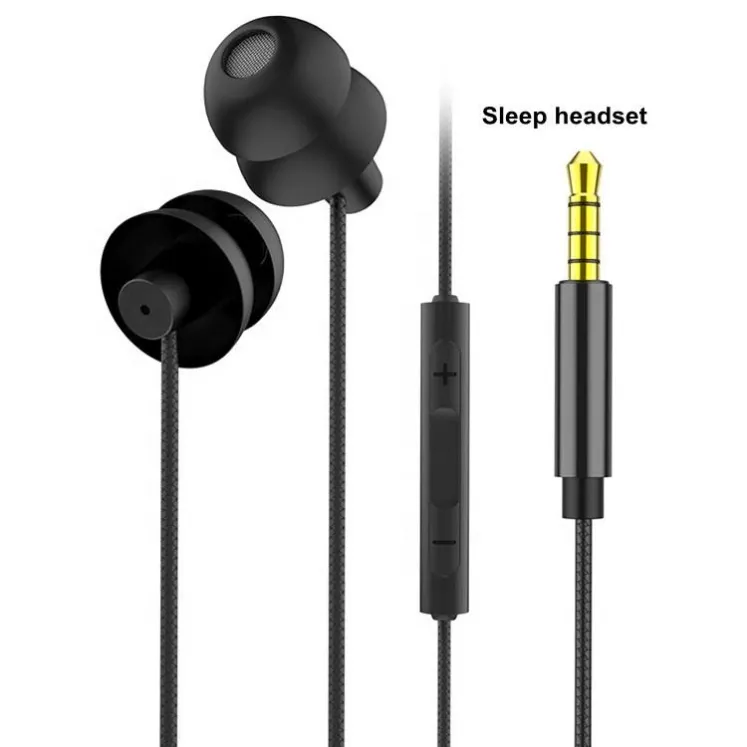
Our EM-015 wired sleep earphones are built around this principle: a compact 6 mm in-ear design that sits inside the ear rather than on top of it, made to be worn lying down.
Check 2: Ear Tips — Soft Silicone, the Right Sizes, a Real Seal
Ear tips are the part of a sleep earphone that touches skin for eight hours. They decide comfort, they decide whether the earphone stays in, and they decide how much outside noise is blocked. They deserve more of your attention than the driver specification.
First, the material. For sleep, the right material is soft silicone — the kind described by sleep earphone suppliers as liquid silicone rubber, soft enough to conform to the ear canal without pressing on it. Hard plastic tips, or tips that are too stiff, create pressure points of their own. Foam tips can be comfortable, but they absorb sweat and need replacing, which is a poor fit for a product sold to be worn every night. Ask the factory what the tips are made of, and ask for the hardness figure if they have one. Suppliers who specialise in sleep models will answer immediately; suppliers who do not will not know what you are asking about, which is itself an answer.
Second, the sizes. One size does not fit all ears, and it certainly does not fit all ears for eight hours. A bulk order should include at least three tip sizes — small, medium and large — and the product should ship with spares. A customer whose ear is smaller than the default tip will have an earphone that falls out; a customer whose ear is larger will have one that presses. Both customers return the product. The fix costs the factory almost nothing and saves you the return.
Third, the seal. A good tip seals the ear canal gently, which blocks a useful amount of outside noise without any electronics. That passive seal is what lets the wearer hear quiet white noise or a sleep story at a low volume instead of turning the volume up to drown out a snoring partner or street noise. When you test a sample, check the seal in both ears, lying on both sides, and listen for whether outside sound drops away. If the seal only works sitting upright, it is not a sleep seal.
Check 3: The Cable — Length, Tangle and the Microphone
A wired sleep earphone has one part a wireless model does not: a cable running across the pillow all night. The cable is where cheap sleep earphones fail quietly, and it is the check most buyers skip.
Length first. A cable that is too short pulls the earphone out when the wearer turns over. A cable that is far too long tangles around the neck and the pillow. For sleep, a length around 120 cm works for most people: long enough to reach a phone on the bedside table or under the pillow, short enough not to coil into a knot. Our EM-015 ships with a 120 cm cable for exactly this reason. Whatever model you buy, confirm the cable length in the specification before you order, and test it on a real bed, not a desk.
Second, the cable itself. It should be flexible and smooth, not stiff. A stiff cable transmits every movement to the earphone — the wearer turns, the cable drags, the earphone shifts. A soft, flexible cable moves with the sleeper instead of against them. Tangle resistance matters too: a cable that knots itself overnight is a cable the customer will complain about in a review, even if the sound is good.
Third, the microphone and remote, if the model has them. A sleep earphone does not need a full inline remote, but a simple microphone is useful for a wearer who takes a call before sleeping. What it must not have is a bulky control module that sits on the cable and presses against the cheek or neck. If the model has an inline remote, check where it falls when the wearer lies down. If it lands under the jaw, ask for a version without it, or a version with the module placed further down the cable.
Check 4: Sound for Sleep — Masking, Not Bass
Sleep earphones are not bought for bass. They are bought to mask noise: a snoring partner, traffic, a neighbour, a humming air conditioner. The sound job is to deliver quiet, steady audio — white noise, rain, a podcast, a sleep story — at a low volume, for hours, without distortion or fatigue.
That changes what to check. You do not need a large driver or a deep bass response. A small, well-tuned driver is enough — the EM-015 uses a 6 mm driver, which is the right scale for this job. What you need is clean sound at low volume, no hiss, and no sharp treble that becomes irritating after an hour. Test the sample at the volume a sleeper would actually use, not at full volume. Play white noise for thirty minutes and listen for hiss. Play a spoken-word recording and listen for sibilance. If the sound is harsh at low volume, it will be unbearable at 3 a.m.
Also check the plug. A sleep earphone is used with a phone on a bedside table or under a pillow, so the plug is bent and moved all night. A gold-plated 3.5 mm plug resists corrosion from sweat and humidity far better than a bare metal plug, and it is worth confirming in the specification. The EM-015 uses a gold-plated 3.5 mm plug. If your customers mostly use phones without a headphone jack, be honest about that in your listing — a sleep earphone with a 3.5 mm plug needs an adapter on those phones, and a customer who discovers that after delivery is a return waiting to happen.
Check 5: Plug Compatibility and the "Will It Work With My Phone" Question
Before any bulk order, settle the compatibility question in writing. A 3.5 mm wired earphone works with any device that has a 3.5 mm jack, and with an adapter on devices that do not. That is simple — but only if your listing says so clearly.
List the connection type prominently. State that the model uses a standard 3.5 mm plug. If you sell to customers with newer phones that have no jack, mention the adapter in the listing rather than leaving the customer to find out. The cheapest return in this category is the one caused by a missing sentence in a product description.
If you are ordering for a specific market, confirm the plug standard the factory uses and ask for a sample tested on the phones your customers actually own. A five-minute test on a real phone beats a specification sheet every time.
Why Wired Still Sells for Sleep
Wireless earbuds dominate the general market, but wired earphones still sell for sleep — and there are practical reasons why.
First, there is nothing to charge. A wireless sleep earbud has to be charged every day, and a dead battery at bedtime means no sleep audio that night. A wired earphone works every night, with no charging routine, no case to remember, and no battery anxiety. For a customer whose whole point is to fall asleep without friction, that matters.
Second, there is nothing to pair. Bluetooth pairing, dropouts and one-earbud-disconnects are minor annoyances during the day and genuine sleep-ruiners at night. A wired connection does not drop out when the phone is under a pillow.
Third, there is no battery in the shipment. TWS earbuds contain lithium batteries, and shipping lithium batteries internationally means extra paperwork and extra rules. A wired earphone has no battery, so the order moves like any other small electronic accessory — simpler to ship, simpler to store, simpler to dropship one order at a time.
Fourth, the price structure is simpler. A wired sleep earphone has fewer components than a wireless one — no battery, no charging case, no Bluetooth chip — which means fewer things that can fail and fewer things that can vary between sample and bulk. For a reseller, that translates into fewer quality complaints and fewer returns.
That is not an argument against wireless sleep earbuds in general. It is an argument for matching the product to the use case: for sleep, the wired model's simplicity is a feature, not a limitation.
Wired vs TWS for Sleep Resale
| Wired sleep earphones | TWS sleep earbuds |
|---|---|---|
Nightly routine | Plug in and sleep — nothing to charge | Charge the case daily, or no audio tonight |
Connection | Wired, no dropouts | Bluetooth — can drop out under a pillow |
Battery in shipment | None — no battery paperwork | Lithium battery — extra shipping rules apply |
Main failure points | Cable, ear tips, plug | Battery, pairing, charging case, firmware |
Best for | Side sleepers, nightly use, low-maintenance resale | Customers who refuse any cable |
Sample testing | Wear overnight, check cable and seal | Wear overnight, check battery life and pairing stability |
If your customers are side sleepers who want something that works every night without thinking about it, wired is the easier sale and the easier product to support. If your customers insist on wireless, test the battery life and pairing stability as hard as you test the fit — our TWS quality checklist covers battery, pairing and drop testing before a bulk order.
How to Test a Sample Before a Bulk Order
Never place a bulk order for sleep earphones on the strength of a specification sheet. Order a sample first, and test it the way a customer would use it. The whole test takes two nights and costs you almost nothing — and it is the cheapest insurance in this category.
Night one: fit and comfort. Wear the earphones to sleep. Lie on your left side, then your right. Note whether the housing presses, whether the earphone stays in when you turn over, and whether your ear is sore in the morning. Check for red marks on the outer ear — a pressure mark is a failed test. Try all three tip sizes across the two nights and find which size seals without pressing.
Night two: cable and sound. Put the phone where a customer would put it — bedside table or under the pillow. Sleep with white noise or a podcast playing at a low volume. Note whether the cable tangles, whether it pulls the earphone out when you move, and whether the sound stays clean for hours. Check the plug in the morning: is it still seated firmly, or has it worked loose?
Daytime checks. Inspect the ear tips for wear after two nights. Pull the cable gently at both ends to check the strain relief. Look at the plug for corrosion or bending. If the model has a microphone, make a test call and check the voice is clear.
If the sample fails any of these checks, tell the factory exactly what failed and ask for a revised sample. A factory that fixes a fit problem before production is a factory worth ordering from. A factory that argues the problem does not exist is a factory to walk away from. Our factory quality control process works the same way: every earphone is tested before shipment, and the sample you approve is the standard the bulk order is held to.
Private Label and Bulk Scenarios for Sleep Earphones
Sleep earphones also suit buyers who are not reselling to individual consumers. Hotels, airlines and wellness brands buy sleep earphones in bulk as guest amenities, in-flight comfort kits and gift items — a scenario where a low-profile, wired model is an easy fit, because there is nothing to charge and nothing to configure.
For those buyers, private label is usually part of the order. At HOEXI, standard earphones start at 1 pc, laser engraving starts at 5 pcs, and custom packaging starts at 500 pcs — so a small test batch with your logo engraved is possible before committing to a full custom box run. Silk printing starts at 500 pcs. Samples take 5–7 days and non-customised bulk orders take 3–7 days, so a first order can be quoted, sampled and shipped inside a few weeks rather than a few months. Our OEM and private label service covers logo engraving, printing and custom packaging for sleep earphones and the rest of our range.
For resellers, the dropshipping route removes the inventory risk entirely: stock nothing, and have each order checked and shipped one at a time. Our dropshipping service covers the EM-015 and our other stocked models, so a sleep earphone listing can go live before any bulk order is placed.
FAQ
Can I order a small quantity first to test the market?
Yes. Standard models start at 1 pc, so you can order a sample batch, test it with real customers, and scale up only when the feedback is good. Laser engraving for your logo starts at 5 pcs.
How long does a sample take?
Samples take 5–7 days. Order the sample in the exact configuration you plan to sell — same tips, same cable length, same plug — because a sample in a different configuration proves nothing about the bulk order.
What should I ask the factory before ordering sleep earphones in bulk?
Five things: housing depth and weight per earbud, ear tip material and included sizes, cable length and flexibility, driver size and low-volume sound quality, and plug type. Get the answers in writing before you confirm the order.
Do wired sleep earphones work with phones that have no headphone jack?
They work with an adapter. Say so in your listing so the customer knows before they buy. A customer who discovers the adapter requirement after delivery is a return you could have prevented with one sentence.
Can sleep earphones be customised with my brand?
Yes. Laser engraving starts at 5 pcs, silk printing at 500 pcs, and custom packaging at 500 pcs. A 30% deposit confirms a bulk order, with the balance before shipment.
The Short Version
A sleep earphone is a fit product first and an audio product second. Before a bulk buy, confirm the housing is flat enough and light enough for side sleeping, the tips are soft silicone in three sizes, the cable is the right length and flexible, the sound is clean at low volume, and the plug matches your customers' phones. Test a sample for two real nights. Then order.
If you are ready to check a sample, get a quote or message us on WhatsApp at +86 135 3021 9863 — tell us the quantity, the tip sizes you need and your delivery country, and we will confirm the sample and the lead time within 24 hours.